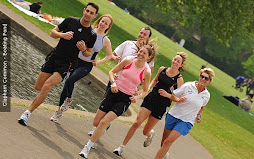
Last Tuesday a few of us went along to hear about how we might optimise our Marathon training, hosted by Balance Physiotherapy. It was a pretty interesting evening, and I think each of us took away at least one new thing to think about when we train, even if we’re not all looking at marathons in 2011. Below I’ve used my (annoyingly incomplete) notes to summarise some of the main points of both lectures. Some will be more interesting/useful/relevant than others, but I hope they have been recorded faithfully and may be one or two of some interest to you.
Lecture 1, delivered by Raphael Rinaldi, on ‘how to prepare your first Marathon injury free’ was a little difficult to follow, but here’s what I picked up:
RUNNING STYLE: be sure to incorporate a torso twist/mobility of the trunk into your running; land on the balls of your and since your ankle receives the most impact when you run (followed by knee), it’s important to have very flexible ankles.
TRAINING: its very important to train to increase your ‘eccentric’ strength. ‘Eccentric’ muscle contraction is when you increase tension on a muscle when it lengthens, so in essence this means that you should train for endurance and stability goals in a way that involves different body areas. Circuits are ideal; with 8-10 stations, 1 min on each station and a minimum of 3 rounds of each station.
He talked about 3 TRAINING PHASES:
1. ADAPTATION – learning to run (applicable if you’re starting from scratch) (1-8 weeks)
2. RUNNING – learning to train – getting fit (9-16 weeks)
3. MARATHON TRAINING.
Underlying narrative: training is not about quantity, but quality. Don’t go out for a run to rack up the miles if you're feeling distracted/under the weather/unmotivated. Do something else instead.
Lecture 2 was given by Dr. Stewart Laing, a Sports Science Consultant at Balance. He seemed to know his stuff; having done several pieces of research into nutrition, including a full review of the relative effectiveness of all sports drinks on the market! *
In essence the aim of training is to improve the ability of your cardiovascular system to transport and deliver oxygen to your muscles, and then to optimise ability of your muscles to be able to use this oxygen. This involves improving your aerobic capacity (by running for longer) and your lactate threshold (by running harder).
To do the former you should try light sustained easy exercise – such as aerobics, light runs and for the latter, you need to do threshold runs, fartlek interval training – all of which are slightly different from one another but should push you into lactate burn and muscle fatigue because you’re at the point at which you shift from aerobic to anerobic activity. If training is effective, you’ll have shifted the point at which lactate begins to accumulate in your body.
NUTRITION: If you run a sub 2hr marathon, your body uses 3000 cals. Slightly less if its sub 4hrs. Ultimately the aim of training is to improve your body’s ability to use carbs and fat energy stores, and to shift the reliance of using carb stores onto fat stores. If you’re doing a run over 45 mins, you should refuel during the run using solid or liquid energy, as you prefer.
FLUIDS: dehydration is inevitable: you sweat around 4 litres in one marathon (1.2l/hour) and so would need to drink 200ml every 15 mins to prevent it. Since this isn’t possible, the next best option is to drink 200ml an hour (sip little and often) and to start hydrated before running. Its definitely wise to practise drinking like this during training to teach your body to tolerate this.
THERMOREGULATING: difficult here to get the right balance between over and under-dressing, especially in the winter. He recommends removing extra layers though as you begin to warm up, so you reduce the risk and negative consequences of overheating.
IMMUNE SYSTEM: some research indicates that moderate exercise increases the body’s immune system nicely, whereas high intensity exercise impairs it. When training for a marathon you’d be classified as doing the latter, so it follows that the risk of getting ill is greatly increased. You can mitigate this slightly by ensuring you don’t train when you’re feeling under the weather, and that you stay hydrated and don’t allow yourself to have a dry mouth. Saliva IgA protects against bacteria and viral infections but cannot be produced if you’re not taking on enough fluids.
*short answer: those with electrolytes, sodium and potassium
Check out performancesportservices.com for more information on this second lecture.
Showing posts with label half-marathon. Show all posts
Showing posts with label half-marathon. Show all posts
Monday, December 13, 2010


Sunday, June 13, 2010
Southend Half Marathon 2010
Funny old game, this running.
My expectations for this race were very low, having had a sluggish few weeks after the VLM, and falling prone to niggles various. Also, I did it last year and wasn't looking forward to the repetitive "up and down the front four times" course.
Still, as a relative new boy to the club, I find that races keep me training, so I had my day at the seaside.
The course is very flat and very boring (up and down, up and down) but it's well managed, with friendly marshals, plenty of water and sponges (ah! the sponges!) as well as the lure of a fine Rossi '99 ice cream at the finish. Lots of club running vests, but also plenty of locals running for the Havens Hospices, who organise the event.
I set off hoping to cling to an 8 minute/mile pace, and was surprised to find it wasn't as tough as I thought it might be. Those speed sessions on a Thursday night really do work, it seems, because I was clocking up enough 7:30s and 7:40s to begin to give me ideas above my station. Maybe I could have a go at my PB, after all (1:40:27 at Hastings in March).

One thing I've learned from the club is that I run faster by training with people who run faster with me. I've spent enough evenings staring at Franks's back, or Krysia's or Fiona's (Mrs Incredible) to have some kind of muscle memory for chasing folk down. And when I run, I count backwards from a hundred.
I know.
Over and over again.
"One hundred, Ninety-nine," etc etc over and over ad infinitum. I'm a great conversationalist, though, honestly.
Anyway, today I put the two together and imagined a digital clock on the back of the runner in front of me. It cut out the negative thinking - Can we just stop please? Isn't this a bit silly? - and helped me forget about worrying injuries into being where none existed.
It worked, because the boring 8,9,10 miles, back along the front for the fourth time, kept me in with a chance of sub 1:45.

I can probably thank England goalie Robert Green for my result, as there must have been plenty of unused adrenaline in my system after watching his USA whoopsy last night. The field was about 1500 and I came in 350th, at 1:41:37; only a minute outside my PB. Not too shabby, as this morning, I'd have been happy with anything under two hours.
As I say, a funny old game.

My expectations for this race were very low, having had a sluggish few weeks after the VLM, and falling prone to niggles various. Also, I did it last year and wasn't looking forward to the repetitive "up and down the front four times" course.
Still, as a relative new boy to the club, I find that races keep me training, so I had my day at the seaside.
The course is very flat and very boring (up and down, up and down) but it's well managed, with friendly marshals, plenty of water and sponges (ah! the sponges!) as well as the lure of a fine Rossi '99 ice cream at the finish. Lots of club running vests, but also plenty of locals running for the Havens Hospices, who organise the event.
I set off hoping to cling to an 8 minute/mile pace, and was surprised to find it wasn't as tough as I thought it might be. Those speed sessions on a Thursday night really do work, it seems, because I was clocking up enough 7:30s and 7:40s to begin to give me ideas above my station. Maybe I could have a go at my PB, after all (1:40:27 at Hastings in March).

One thing I've learned from the club is that I run faster by training with people who run faster with me. I've spent enough evenings staring at Franks's back, or Krysia's or Fiona's (Mrs Incredible) to have some kind of muscle memory for chasing folk down. And when I run, I count backwards from a hundred.
I know.
Over and over again.
"One hundred, Ninety-nine," etc etc over and over ad infinitum. I'm a great conversationalist, though, honestly.
Anyway, today I put the two together and imagined a digital clock on the back of the runner in front of me. It cut out the negative thinking - Can we just stop please? Isn't this a bit silly? - and helped me forget about worrying injuries into being where none existed.
It worked, because the boring 8,9,10 miles, back along the front for the fourth time, kept me in with a chance of sub 1:45.

I can probably thank England goalie Robert Green for my result, as there must have been plenty of unused adrenaline in my system after watching his USA whoopsy last night. The field was about 1500 and I came in 350th, at 1:41:37; only a minute outside my PB. Not too shabby, as this morning, I'd have been happy with anything under two hours.
As I say, a funny old game.

Subscribe to:
Posts (Atom)